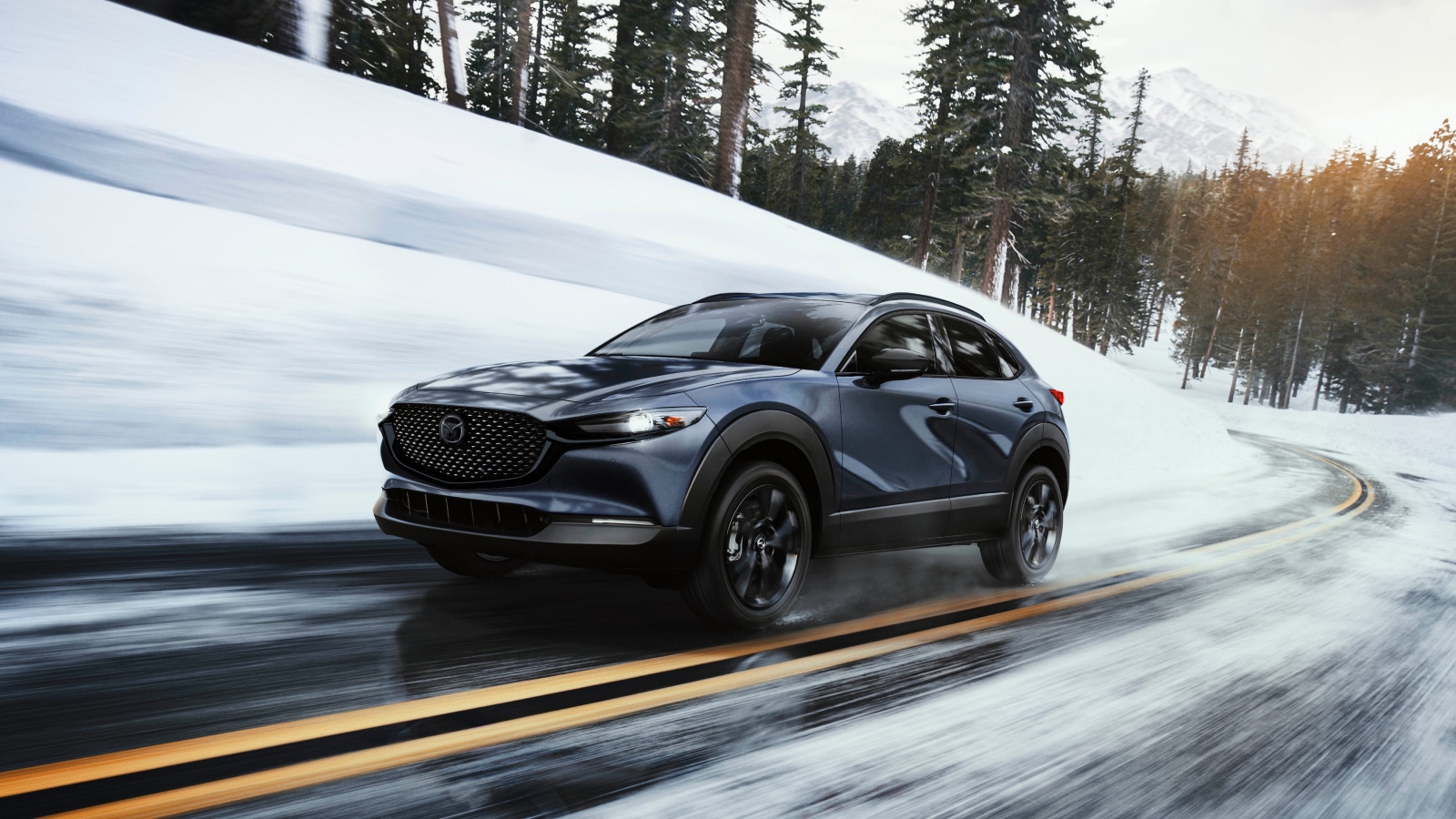
2026 Mazda CX-30 vs Honda HR-V
If you can't decide between the Mazda CX-30 and Honda HR-V, you're not alone. These popular subcompact SUVs both deliver daily practicality and good fuel efficiency, but they're surprisingly different beneath the surface. In this guide, we explore their features and help you decide which one might be your perfect match.
Mazda CX-30 vs. Honda HR-V: Overview and Key Differences
Although the 2026 Mazda CX-30 and 2026 Honda HR-V are similar, and both serve as entry-level SUVs for their brands, they target different drivers.
Mazda's approach leans toward luxury with the CX-30's sharp grille, crisp body lines, and added cladding. Honda's HR-V takes a more practical path with its rounded shape and less aggressive styling. This also carries over inside, where the CX-30 offers soft-touch materials and leatherette padding for your hands and arms, and the HR-V is well-built but lacks some of the finer touches. Both models include plenty of safety technology and come standard with wireless Apple CarPlay and Android Auto, so your phone connects easily in either one.
The biggest practical difference is space. Honda's clever interior layout gives the HR-V 98.7 cubic feet of passenger volume, compared to 94.1 cubic feet in the CX-30. You may notice the extra room when driving with family or friends. Still, the CX-30's strong ranking suggests many buyers are happy to trade some room for the Mazda's better driving feel and high-quality materials. Schedule a test-drive to experience the Mazda CX-30 at our dealership in Bountiful.
Performance and Driving Dynamics
The Mazda CX-30 uses a 2.5-liter four-cylinder engine that produces 191 horsepower and 186 lb-ft of torque. The HR-V offers a single engine option across all trims: a 2.0-liter four-cylinder generating 158 horsepower and 138 lb-ft of torque. This power gap becomes clear when you accelerate. The CX-30 reaches 60 mph in 8.1 seconds, while the HR-V takes 9.4 seconds.
If you want more power, the Mazda offers a turbocharged option that generates 250 horsepower and cuts the 0 to 60 time to just 5.8 seconds. That's quick enough to make mountain drives enjoyable. Every CX-30 comes with all-wheel drive (AWD) as standard, making it ideal for winter weather. The HR-V uses front-wheel drive as the default, and you have to pay extra for AWD.
Take both vehicles through some curves, and you'll appreciate how sporty the Mazda feels with quick, precise steering that makes winding roads enjoyable. Honda built the HR-V for comfort, with a softer suspension that absorbs bumps but feels less responsive on twisty roads. If driving is more than just getting from one place to another, the CX-30's sharp handling might appeal to you more.
Fuel Efficiency Comparison
You might expect the CX-30's larger engine to use more fuel, but that isn't the case. The Mazda actually edges out the Honda in fuel efficiency. The standard CX-30 gets 26 mpg in the city and 33 mpg on the highway. The HR-V trails slightly with 26 mpg in the city and 32 mpg on the highway. It's reassuring to know you can get that stronger performance without extra trips to the gas station.
If you choose the turbo CX-30, fuel economy drops to 22 mpg in the city and 30 mpg on the highway. The highway rating remains high, which matters if you regularly take long drives.
Interior Space and Practicality
The HR-V is the winner when it comes to space. Honda makes use of every inch of its 179.8-inch length compared to the CX-30's 173 inches. Front legroom is nearly identical at 41.9 inches in the HR-V and 41.7 inches in the CX-30, but rear passengers enjoy 37.7 inches of legroom in the Honda compared to 36.3 inches in the Mazda. That extra space makes a difference on longer trips.
Cargo space further separates these two models. The HR-V offers 24.5 cubic feet behind the rear seats and 55.1 cubic feet when folded down, while the CX-30 provides 20.2 cubic feet behind the seats and 45.2 cubic feet with the seats folded. In real-world testing, reviewers were able to fit 14 donut boxes in the HR-V but only nine in the CX-30. If you frequently carry camping gear or sports equipment, that extra space could be the deciding factor.
Interior Quality and Features
Technology-wise, both SUVs come with eight-speaker sound systems that do the job without being especially impressive. Screen sizes vary, with the CX-30 starting with an 8.8-inch display, upgrading to 10.25 inches in higher trims, with Alexa Built-in. The HR-V offers a 9-inch screen as standard. Mazda's system uses a control knob that you may find easier to use while driving than Honda's touch screen.
The HR-V has leather seats on its top trim but skimps on lumbar support. The CX-30 feels more upscale with leatherette and suede seats in selected trims, plus memory settings that remember your preferred seating position. On long drives in Utah, the added back support can significantly contribute to your comfort.
Regarding safety, both cars earned Top Safety Pick+ ratings from the Insurance Institute for Highway Safety. The Honda HR-V also earned a five-star rating from the National Highway Traffic Safety Administration. The Mazda CX-30 scores just as high in crash tests. Either choice provides solid protection for yourself and your passengers.
Experience the Mazda CX-30 Today
So which one's right for you? It ultimately comes down to what matters most in your daily life. If maximum interior space for cargo and rear-seat passengers is your top priority, the HR-V makes sense. If you prefer a car that's enjoyable to drive, offers higher-quality materials, includes AWD standard for Utah winters, and delivers quicker acceleration, the CX-30 is a better fit for you. Ready to experience the difference for yourself? Contact us at Bountiful Mazda and take the CX-30 for a test-drive today.