2026 Mazda CX-50 vs. Hyundai TUCSON
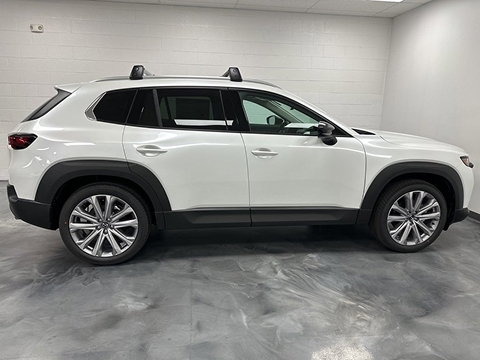
The 2026 Mazda CX-50 and Hyundai TUCSON are two standout compact SUVs. The main difference between these crossovers is that the Mazda focuses on driving excitement, while the Hyundai emphasizes interior space. To help you decide which model is right for you, we'll compare these models head-to-head across performance, space, tech, and value.
Engine Performance and Driving Dynamics
Both SUVs start with similar 2.5-liter four-cylinder engines that produce 187 horsepower. The CX-50's base engine has 185 lb-ft of torque, compared to the TUCSON's 178 lb-ft of torque. With the 2026 CX-50, you can also choose a more powerful turbocharged 256-horsepower engine, making it perfect for mountain passes around Salt Lake City.
The TUCSON Hybrid combines a turbo 1.6-liter with an electric motor for 231 horsepower. In comparison, the CX-50 Hybrid gets a total of 219 horsepower using a 2.5-liter four-cylinder engine.
The gas-powered CX-50s use a six-speed automatic transmission, while its hybrid version gets a continuously variable transmission. Hyundai gave the TUCSON's gas engines an eight-speed automatic transmission, and the TUCSON Hybrid comes with a six-speed automatic.
One of the CX-50's main advantages is that all-wheel drive is standard across every trim. You'll have to pay extra for all-wheel drive with a TUCSON.
Towing Capacity
When it comes to towing, the CX-50 has an advantage. Using the CX-50's base engine, you can tow up to 2,000 pounds. By upgrading to the turbocharged engine, your towing capacity increases to 3,500 pounds, and you get a special Towing driving mode. The TUCSON can tow up to 1,650 pounds without trailer brakes or 2,750 pounds with trailer brakes. The CX-50's higher towing capacity makes this SUV ideal for hauling small boats or camping trailers up to Buckland Flats Campground.
Fuel Economy
Both SUVs get comparable gas mileage. The CX-50's base engine manages 24/30 mpg (city/highway), and its turbo engine achieves 23/29 mpg. A front-wheel-drive TUCSON can get up to 25/33 mpg, and upgrading to all-wheel drive drops the efficiency slightly to 24/30 mpg. The CX-50 Hybrid and TUCSON Hybrid both get 38 mpg combined. However, the CX-50 Hybrid has a slightly larger range at 551 miles, compared to the TUCSON Hybrid's 521-mile range, making it perfect for going up and down I-15.
Interior Space, Comfort, and Practicality
Whether you choose the TUCSON or CX-50, you'll get an SUV with high-quality interior materials, such as leatherette or leather seating. However, these SUVs offer different amounts of interior space.
The TUCSON has 108.2 cubic feet of passenger volume. The front seats get 41.4 inches of legroom, and your rear-seat passengers will have 41.3 inches of legroom. With the rear seats folded, you'll have a total of 80.3 cubic feet of cargo volume, and with all of the seats up, there's 41.2 cubic feet of cargo space.
The 2026 CX-50 passenger volume totals 100.3 cubic feet. Your front and rear passengers will have 41.7 and 39.8 inches of legroom, respectively. Behind the second row, you'll have 31.4 cubic feet of cargo room. If you fold the rear seats, the cargo volume expands to 56.3 cubic feet, so you'll have plenty of space for all your kids' soccer gear for the game at Peak Soccer Club.
Technology, Infotainment, and Connectivity
The TUCSON and CX-50 both feature a good selection of modern tech. In the CX-50, you'll get a 10.25-inch central touch screen, and the TUCSON offers a 12.3-inch display. Both come standard with wireless Apple CarPlay and Android Auto. You can also upgrade to a Bose sound system in each SUV. However, the CX-50 offers a 12-speaker Bose audio system, compared to the TUCSON's upgraded eight-speaker system. The CX-50 exclusively offers standard wireless phone charging and Alexa Built-in.
Safety and Driver-Assistance Features
The CX-50 and TUCSON offer a similar array of safety technologies and driver-assistance features. Each SUV comes standard with automatic emergency braking, blind-spot monitoring, lane-keep assist, and adaptive cruise control. On higher trims, you can get parking sensors and a 360-degree camera system. While the National Highway Traffic Safety Administration hasn't tested the 2026 TUCSON, the CX-50 earned a five-star overall safety rating.
Hyundai vs. Mazda: Which SUV Is Right for You?
The CX-50 begins at $29,900, and the highest trim starts at $42,900. A TUCSON will start between $29,200 and $39,175. The hybrid models of each SUV have a higher starting price, with the Mazda and Hyundai beginning at $34,750 and $32,200, respectively.
Other than price, your choice mainly depends on two factors: what kind of driving experience you'd like and how much storage you need. If you prefer better performance and don't need as much cargo space, the CX-50 is an ideal choice.
Find Your CX-50 at Bountiful Mazda
If you're interested in the 2026 CX-50, we invite you to visit our dealership in Bountiful, Utah, for a test drive. It's the best way to see if this SUV's performance and quality fit with what you're looking for. Our friendly team can also answer any of your questions and help you choose the right trim. Contact us today to schedule a visit.